
By Tara
Last Thursday I saw on Twitter that Odette Toilette had a last minute spot available on her day trip to the Osmotheque Perfume Museum and Conservatory. I messaged her straight away and took the place. Exciting!
Therefore, (not so) bright and very early on Monday (6.30am) I joined about 20 other fragrance fanatics to board the Eurostar at St. Pancras International in London. Odette was concerned her sequined skirt looked a little “walk of shame” at that time in the morning but I thought she looked great.
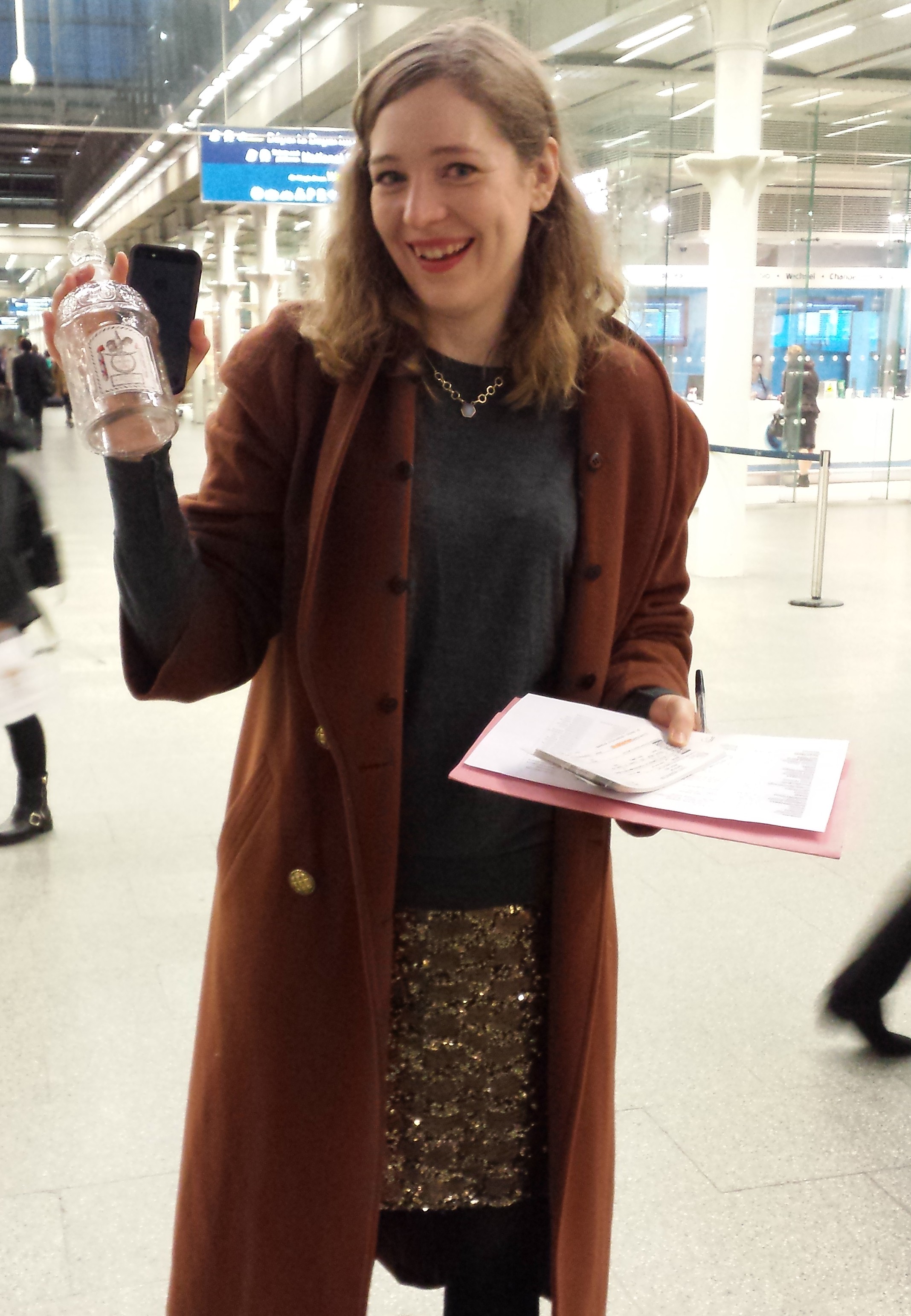
Odette Toilette at the Eurostar Terminal
The roughly two and a half hour journey went surprisingly quickly and there was a coach to meet us at the Gare du Nord. We set off for lunch at a restaurant based inside an art gallery just across from the Seine. The meal proved interesting. We had to pick our courses in advance but there was some confusion over the French translation.
![Siene and Tower[1]](https://olfactoriastravels.com/wp-content/uploads/2014/11/siene-and-tower1.jpg)
A view of the Eiffel Tower and the Seine in passing
![Caramel chicken[1]](https://olfactoriastravels.com/wp-content/uploads/2014/11/caramel-chicken1.jpg)
Caramel chicken
![Art Gallery[1]](https://olfactoriastravels.com/wp-content/uploads/2014/11/art-gallery1.jpg)
We then went thorough to a lecture room where Patou perfumer and Osmotheque curator, Thomas Fontaine, took us through around 30 vintage perfumes.
Thomas was nothing short of wonderful. He was extremely open about his profession and in touch with the sensual side of perfume.
![Raw materials[1]](https://olfactoriastravels.com/wp-content/uploads/2014/11/raw-materials1.jpg)
raw materials
We each had a holder of little envelopes in which to slip the paper strips with perfume that were handed around so we could experience the drydown later. Thomas told us a little about each one with a screen showing factual information and pictures of the bottles. Now I hope M. Fontaine will forgive me for mangling his words but the following will give you an idea about some of what he said.
![Thomas Fontaine[1]](https://olfactoriastravels.com/wp-content/uploads/2014/11/thomas-fontaine1.jpg)
Thomas Fontaine
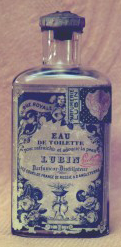
Thomas: This fragrance features citrus notes but it is also very spicy. Clove and cinnamon are known for their anti-bacterial properties so this eau de toilette was used to help people keep clean.
Le Vinaigre des 4 Voleurs, 1800
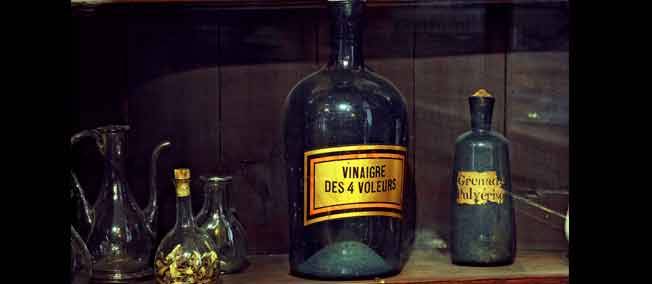
Thomas: Legend has it that in the Middle Ages at a time of disease thieves were stealing and not getting infected. The police asked them how this was so and they claimed it was a fragrance of spices suspended in vinegar.
At the time this fragrance was launched there was not much of a distinction between perfumers and pharmacists. Many pharmacists created perfumes for medicinal purposes.
They were using naturals but when synthetics were developed this opened up whole new ideas. The first important new molecule was coumarin which was first synthesised in 1868 and many more followed such as vanillin, ionones, synthetic musks, aldehydes, linalool and more recently, ambrox.
Fougere Royale, Houbigant 1882
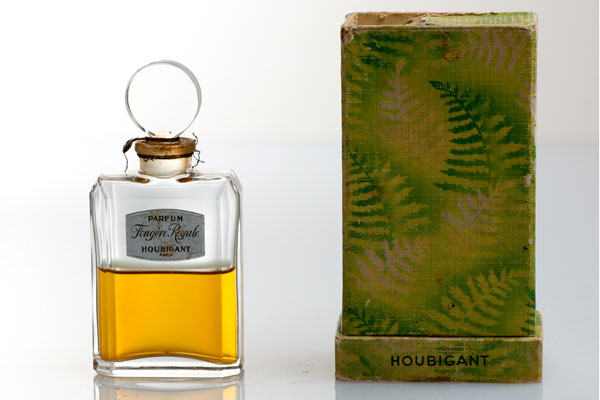
Thomas: This is 50% coumarin and a new accord was created – the fougère.
Group member: It’s woodier and less soapy than the current version.
Thomas: Well, you could re-create it the same as this version but you couldn’t sell it because of IFRA and EU regulations. They are becoming more restrictive and it’s becoming harder and harder for perfumers. We came close to not being able to use any natural rose and jasmine recently because they contain allergens for 0.2% of the population.
We are not such a big lobby as the cigarette manufacturers. In France 70,000 people a year die from smoking but this product is still on the market.
Jicky, Guerlain, 1899
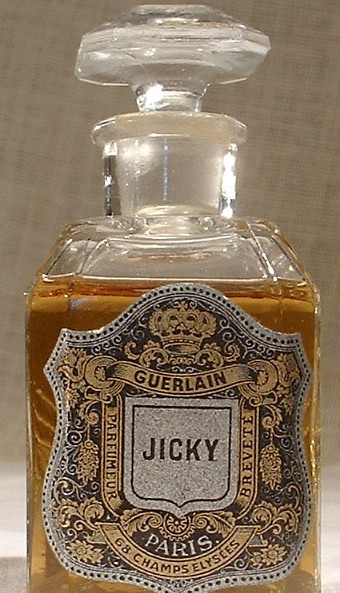
Thomas: This was created by Aimé Guerlain and is an example of vanillin and coumarin. A lot of men love it, I even wear Jicky. Guerlain went on to create a similar fragrance called Mouchoir de Monsieur.
Vera Violetta, Roger & Gallet, 1892
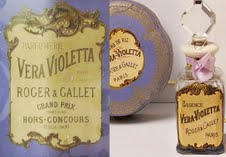
Thomas: This means “Real Violet”. It was the fist fragrance to use the new molecule, ionone to recreate the smell of violets.
Group member: It’s very carrot-y/iris-y.
Thomas: In iris you can smell a violet element. But using ionones is a lot cheaper than using orris root which is the most expensive natural in the world. Synthetics made fragrances easy to read. Naturals need synthetics to develop and synthetics need naturals to add richness.
Narcisse Noir, Caron 1911
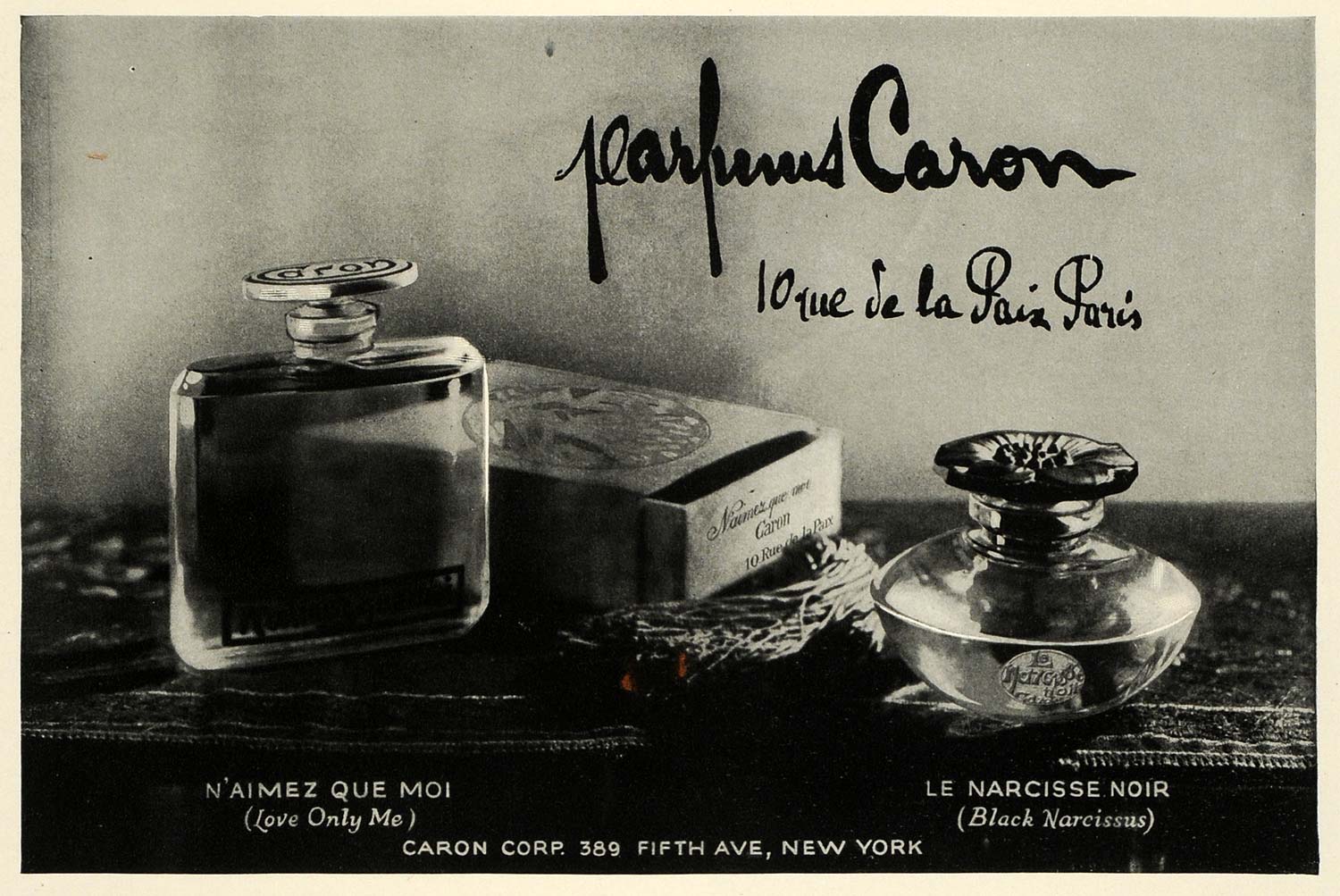
Thomas: This has a lot of narcisse and some tuberose. The modern version has more tuberose, which is cheaper.
Coty
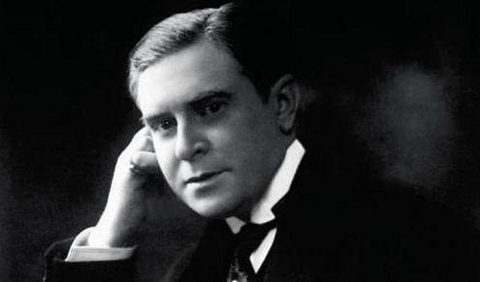
Thomas: Francois Coty introduced sensuality into perfume. He created a company at the beginning of the twentieth century which revolutionised the industry. He created so many new and important fragrance families including ambers and chypres.
New techniques of extraction were developed also at this time. Extraction using solvents to create absolutes replaced enfleurage.
Perfumes were still copies of nature however. Abstraction didn’t come till later with perfumes like Chanel No.5. There were a lot of soliflores on the market.
Ambre Antique, Coty 1905

Thomas: An amber accord was created using vanillin and labdanum. The vanilla contributed sweetness and the labdanum contributed warmth. This inspired new fragrances such as Shalimar which added bergamot and Habanita which added vetiver. So the accord is developing with each new creation.
Un Air Embaumé, Rigaud, 1914
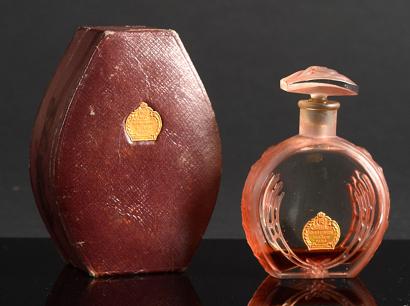
Thomas: The benzyl acetate here adds fruitiness.
Group member: Can you recreate the very old perfumes and sell them today?
Thomas: Take for example Black Jade which I created for Lubin. It was inspired by Marie-Antoinette’s fragrance. But of course it doesn’t smell like Marie Antoinette’s fragrance. We have the formula. If it did, no one would wear it. We have to create a fragrance that will sell and make money so we create a commercial interpretation.
(Editor’s Note: I cannot resist to put in a little, “Ha!” at this point. Was that not what I said? Why did the CEO of Lubin feel the need to publicly scold me for saying so? And yes, I have a hard time forgiving and forgetting… 😉 )
Although I don’t like the word “commercial”. You don’t have to make a perfume appeal to the mainstream for Lubin and Patou. You just need some people to love it. When you make a perfume for Proctor and Gamble it has to sell thousands and thousands, probably more.
L’Heure Bleue (EDP), Guerlain 1912
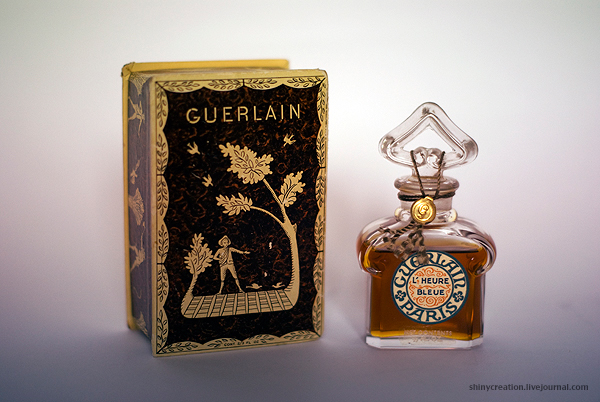
Thomas: L’Heure Bleue uses orange flower and jasmine alongside coumarin.
Le Fruit Defendu, Les Parfums de Rosine 1916
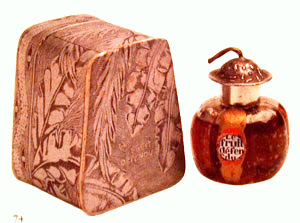
Thomas: Paul Poiret was the first fashion designer to link perfume with fashion. However, he didn’t put his name on the bottles but used his daughter’s name, Rosine, instead.
This is very spicy with clove and cinnamon but also has fruity accords like peach.
A Side Note on Animalics
Thomas: We are animals so we like animalics – except maybe the Americans! Jicky used 1-2% civet. We use cumin because it smells like sweat and we use costus because it smells of hair. We are all driven by odours.
Chypre, Coty 1917
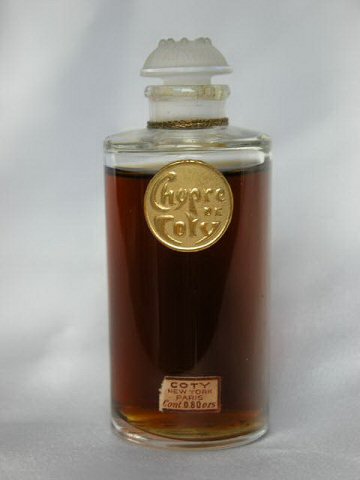
Thomas: Named after the island of Cyprus. It has cistus labdanum, bergamot, rose and oakmoss. For me, the chypre is one of the most sensual accords.
Tabac Blond, Caron 1919
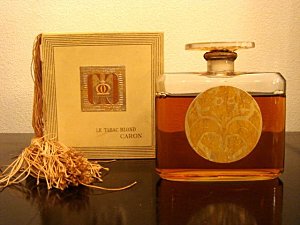
Thomas: Cigars used to be impregnated with civet and most of the tobacco shops in France were called “Civet” . Tabac Blond combined narcisse and civet. One woman who tried this said to me “It smells of my grandmother”. This wasn’t because her grandmother wasn’t clean but because it reminded her of her grandmother’s furs.
Crêpe de Chine, Millot 1925
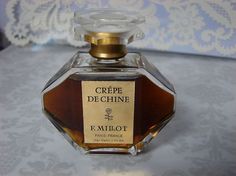
Thomas: In the twenties more raw materials were available from across the globe, from places such as China and the Middle East.
Arpége, Lanvin 1927
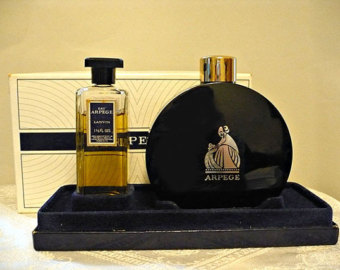
Thomas: Chanel No.5 was the first perfume to use such a large amount of aldehydes. It created a new genre of fragrance – the floral aldehyde. Arpége came along a few years later using the same accord.
Joy, Patou 1930
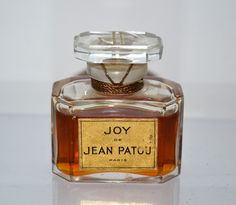
Thomas: This was originally intended as a gift for Patou’s special clients. The perfumer thought it would be impossible to produce because of the expense of his formula which had a 80-90% mixture of rose and jasmine. I smell it nearly everyday and it changes. It has perfect balance. Considering the cost of the raw materials it’s the best value for money perfume on the market today.
Maybe one day we will have to make a big stand against IFRA and the EU regulations because every year there are new restrictions and every year we have to reformulate. It’s a big mess because there are different regulations in the US and Japan but the European rules are the most strict.
Some of the other vintage fragrances we tried were:
La Rose Jacqueminot, Coty 1906
Bouquet de Faunes, Guerlain 1922
Chaldee, Patou 1927
Soir de Paris, Bourjois 1928
Tabu, Dana, 1932
Je Reviens, Worth 1932
Scandal, Lanvin 1933
Shocking, Schiaparelli 1937
L’Air du Temps, Nina Ricci 1948
1000/Mille, Patou 1972
![Fridge bottles[1]](https://olfactoriastravels.com/wp-content/uploads/2014/11/fridge-bottles1.jpg)
Fragrances protected in dark bottles and argon gas fridges
![The Vault[1]](https://olfactoriastravels.com/wp-content/uploads/2014/11/the-vault1.jpg)
“The Vault”
Then it was time to head back to the station to catch the 7.13pm Eurostar home. It was delayed, but once onboard, Odette passed around paper strips with the perfume each person had requested ahead of the trip.
![Odette and me[1]](https://olfactoriastravels.com/wp-content/uploads/2014/11/odette-and-me1.jpg)
Odette and Tara
Odette opened a couple of bottles of Champagne to celebrate our fantastic day out.
Would you like to visit the Osmotheque? What fragrance would you love to smell in vintage form?


![20141023_195136[1]](https://olfactoriastravels.com/wp-content/uploads/2014/10/20141023_1951361.jpg)
![20141023_205943[1]](https://olfactoriastravels.com/wp-content/uploads/2014/10/20141023_2059431.jpg)
![20141023_200808[1]](https://olfactoriastravels.com/wp-content/uploads/2014/10/20141023_2008081.jpg)
![20141023_203056[1]](https://olfactoriastravels.com/wp-content/uploads/2014/10/20141023_2030561.jpg)







 Olfactoria's Travels